
The Challenge
Ultra-short nucleic acids are difficult to recover.
Ultra-short nucleic acid fragments are increasingly recognized as important targets in small RNA profiling, cfNA research, fragmentomics, and biomarker discovery. However, conventional purification methods often lose a large portion of fragments below 25 nt[1], [2]. This can distort the original nucleic acid profile and limit access to valuable short-fragment information.
DeepCatch™ was developed to solve this problem. (Fig 1)
Technology Principle
Flexible binding cavities for reversible capture
DeepCatch™ is built on a proprietary flexible-interface magnetic bead technology.
By modifying the surface of magnetic beads, DeepCatch™ creates flexible binding cavities that interact reversibly with nucleic acids. Through subtle and reversible conformational changes, these cavities enable efficient nucleic acid binding during capture and easy release during elution.
This design significantly improves the enrichment of ultra-short nucleic acids without the need for carrier RNA, carrier DNA, glycogen, PEG, LPA, or similar additives. The result is a cleaner, carrier-free nucleic acid preparation system with strong recovery of ultra-short fragments down to 10 nt.
Core Advantages
Designed for short-fragment recovery, flexible enrichment, and clean downstream analysis.
Flow-Through Rescue (Fig 1)
Recovers short and ultra-short RNA and DNA fragments that are under-captured and discarded in the flow-through of conventional purification kits.
Flex-Range Options (Fig 3)
User-selectable recovery ranges, including 15 nt for Standard Mode and 10 nt for Discovery Mode.
Size Fractionation (Fig 4)
Supports high-resolution size fractionation, allowing users to enrich defined fragment ranges while reducing background.
Carrier-Free Workflow (Fig 2)
No carrier RNA/DNA, glycogen, PEG, or LPA required, helping reduce artificial background and carryover.
Downstream Compatible (Fig 5)
Purified nucleic acids are perfectly suited for qPCR, ddPCR, adapter ligation, and NGS library preparation.
Improved Signal-to-Noise
By enriching informative short fragments and reducing background, DeepCatch™ improves analytical sequencing efficiency.
Ultra-Low-Volume Concentration
Concentrates up to 200 µL of purified DNA and RNA into as little as 5 µL while retaining broad-range fragments down to 10 nt, enabling more molecules to enter volume-limited downstream assays. View Concentration Kit
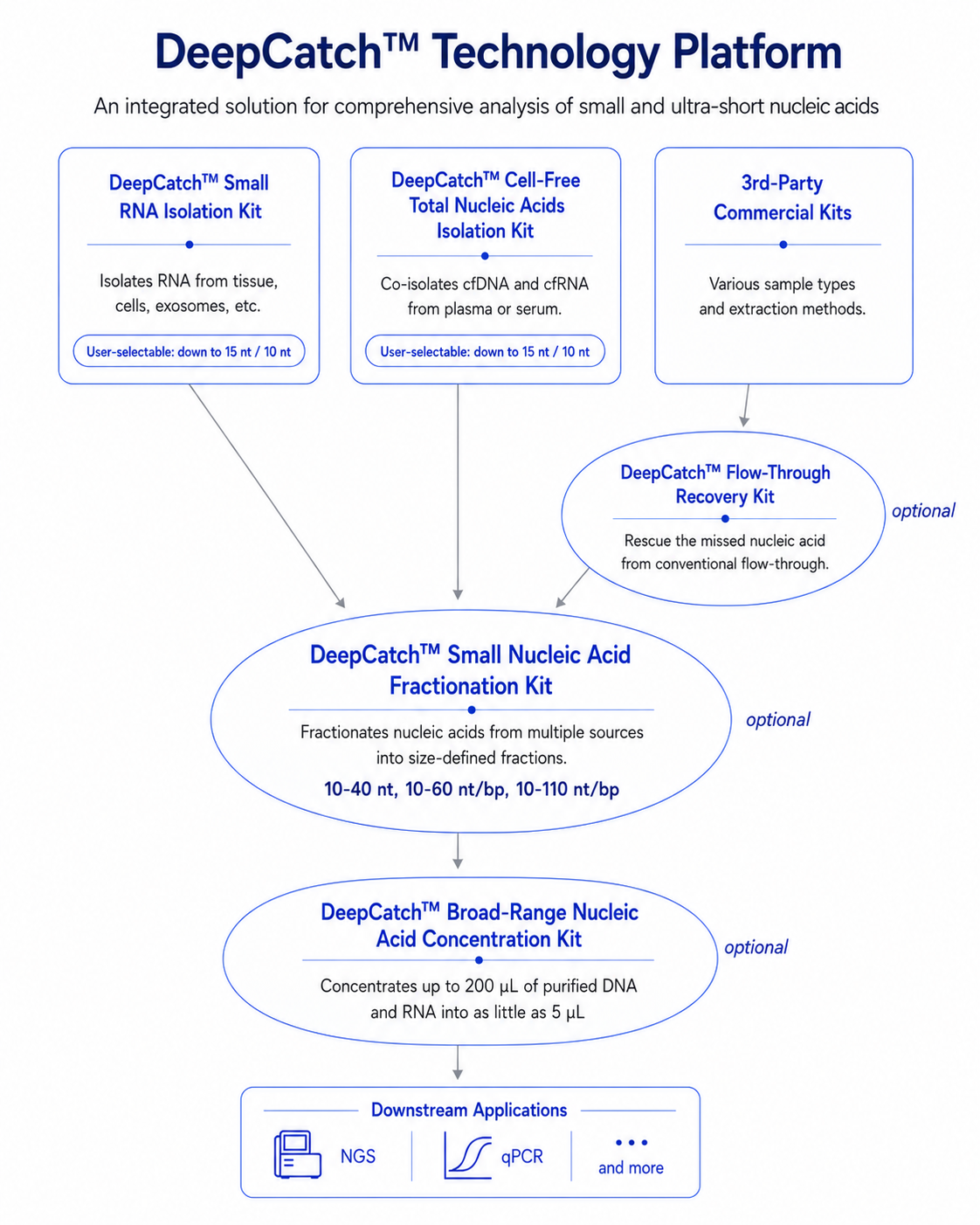
Integrated Solution for Small and Ultra Short Nucleic Acids
Experimental Data
DeepCatch™ Overcomes Critical Short-Fragment Loss in Conventional Methods
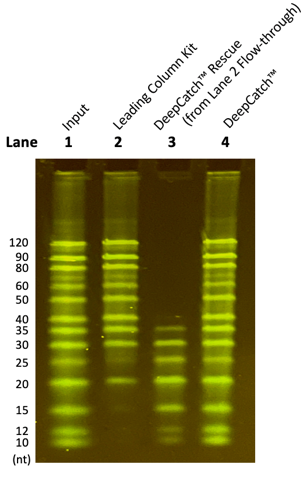
Fig 1. DeepCatch™ captures ultra-short fragments missed by conventional methods. A synthetic nucleic acid marker panel ranging from 10 to 120 nt was used as input (Lane 1). Extraction was performed in parallel using a leading column kit (Lane 2) and the DeepCatch™ Technology Platform (Lane 4). Results indicate that the conventional column method (Lane 2) begins to lose significant yield at 35 nt, with dramatic loss below 30 nt and near-complete loss of fragments ≤15 nt. In contrast, the DeepCatch™ system (Lane 4) utilizing optimized binding buffers and flexible-interface magnetic beads, efficiently recovered the entire size range down to 10 nt. Furthermore, when DeepCatch™ magnetic beads were applied to the flow-through waste of the conventional kit (Lane 3), they successfully rescued the ultra-short fragments (15-35 nt) that the standard method failed to capture. (Note: Sub-optimal recovery of 10 nt and 12 nt in Lane 3 is due to the non-optimized binding conditions of the competitor's flow-through matrix, highlighting the importance of the complete DeepCatch™ system in Lane 4). Analyzed on 15% denaturing Urea-PAGE with SYBR staining.
Fig 1. DeepCatch™ captures ultra-short fragments missed by conventional methods. Nucleic acid markers (10-120 nt) were processed using a leading column kit (Lane 2) and the DeepCatch™ platform (Lane 4). The conventional kit showed significant loss starting at 30 nt, with severe loss below 20 nt. DeepCatch™ successfully recovered the full spectrum down to 10 nt (Lane 4) and even rescued the lost ultra-short fragments directly from the conventional kit's flow-through (Lane 3). (15% Urea-PAGE, SYBR staining).
Are your critical targets slipping into the flow-through?
Don’t discard it before you know what’s there.
Highly Efficient, Carrier-Free Recovery of Trace Ultra-Short Nucleic Acids
DeepCatch™ achieves >90% recovery of 10 nt fragments at picogram levels, while conventional methods fail.
Fig 2. Highly efficient, carrier-free recovery of trace ultra-short (10 nt) nucleic acids. Blank samples (-) and samples spiked with 880 pg of a FAM-labeled 10 nt synthetic nucleic acid (+) were prepared to evaluate recovery efficiency at trace levels. Samples were divided into three groups: an unextracted control (Input), extraction using the DeepCatch™ platform, and extraction using a leading column kit. All extraction workflows were performed without the addition of carriers (such as glycogen, LPA, or carrier RNA). Following purification, the fluorescence signal of the resulting eluates and the unextracted input controls were directly read using a fluorometer. The DeepCatch™ system successfully recovered >90% of the 10 nt fragments, maintaining high efficiency even at picogram-level inputs. In contrast, the leading column kit failed to capture the ultra-short fragments, yielding a fluorescence signal indistinguishable from the background level of the negative control. These results demonstrate the capability of DeepCatch™ technology to preserve ultra-short nucleic acid populations that are lost by conventional methods.
Flex-Range Recovery: User-Selectable Size Cutoffs
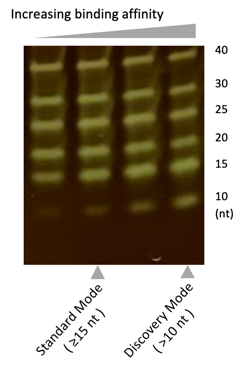
Fig. 3. DeepCatch™ Flex-Range technology enables user-selectable lower-size recovery. A nucleic acid marker panel ranging from 10 to 40 nt was purified under four DeepCatch™ formulations designed to systematically increase the binding affinity and analyzed by 15% denaturing urea-PAGE with SYBR staining. From left to right, increasing binding affinity gradually extended recovery toward shorter fragments while maintaining recovery of the larger markers. Under the lower-affinity conditions, the 15-40 nt fragments were efficiently recovered, whereas the 10 nt fragment was largely excluded. As binding affinity increased, recovery of the 10 nt fragment progressively improved and became clearly detectable under the highest-affinity condition. Based on these profiles, two operating conditions were selected: Standard Mode (≥15 nt cutoff) for routine applications that exclude the shortest fragments, and Discovery Mode for broader ultra-short nucleic acid recovery extending to the 10 nt range. Other intermediate conditions illustrate the tunable transition between these recovery profiles and demonstrate how DeepCatch™ binding conditions can be adjusted to match different downstream applications.
Fig. 3. DeepCatch™ Flex-Range technology enables two selectable recovery modes. Nucleic acid markers ranging from 10 to 40 nt were purified using varying DeepCatch™ buffer conditions. Modulation of the binding chemistry shifted the lower size recovery threshold, supporting two user-selectable modes: Standard Mode (≥15 nt cutoff) and Discovery Mode (>10 nt cutoff). This allows users to select the recovery range best suited to different downstream applications. (15% denaturing urea-PAGE, SYBR staining.)
Not sure which recovery range or DeepCatch™ workflow fits your research?
Targeted Size Fractionation of Nucleic Acids
Selectively deplete longer background fragments to enrich focused fractions of short nucleic acids.
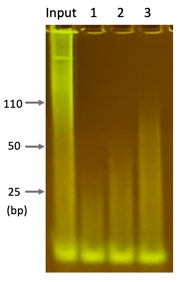
Fig 4. Selectable size fractionation using DeepCatch™ technology. A broad smear of DNase I-degraded plasmid DNA (Input) was processed using three DeepCatch™ fractionation protocols. By adjusting the binding conditions, higher-molecular-weight species were selectively depleted, thereby enriching short-fragments. The resulting eluates predominantly retain fragments approximately 25, 50, and 110 bp in Lanes 1, 2, and 3, respectively. These results demonstrate the platform’s flexible ability to selectively enrich defined short-fragment ranges for focused downstream analysis. (10% non-denaturing PAGE, SYBR staining).
Fig 4. Selectable size fractionation using DeepCatch™ technology. A broad smear of DNase I-degraded plasmid DNA (Input) was processed using three DeepCatch™ fractionation protocols. By adjusting the binding conditions, higher-molecular-weight species were selectively depleted, thereby enriching short-fragments. The resulting eluates predominantly retain fragments approximately 25, 50, and 110 bp in Lanes 1, 2, and 3, respectively. These results demonstrate the platform’s flexible ability to selectively enrich defined short-fragment ranges for focused downstream analysis. (10% non-denaturing PAGE, SYBR staining).
Downstream Enzymatic Compatibility of DeepCatch™ Eluates
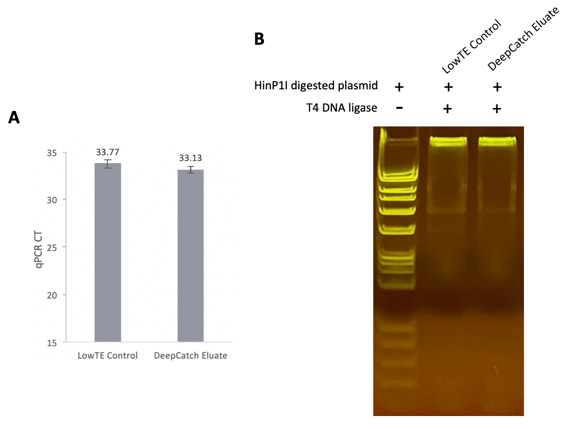
Fig 5A. DeepCatch™ eluate shows no detectable qPCR inhibition. To evaluate downstream compatibility, 60 copies of PRRSV template were spiked directly into either a standard lowTE buffer (Control) or a DeepCatch™ eluate obtained from bovine plasma cell-free nucleic acid extraction. qPCR amplification using PRRSV-specific primers and probes showed comparable Ct values (33.77 ± 0.42 for lowTE vs. 33.13 ± 0.35 for DeepCatch™). These results indicate that DeepCatch™ yields high-purity eluates without detectable inhibition of sensitive qPCR amplification.
Fig 5B. DeepCatch™ eluate shows no detectable inhibition of DNA ligation. To confirm compatibility with downstream library preparation workflows, equal amounts of HinP1I-digested plasmid DNA (Lane 1) were spiked into either lowTE buffer (Lane 2) or a DeepCatch™ eluate derived from a bovine plasma extraction (Lane 3). Ligation reactions were performed using T4 DNA ligase at 25°C for 30 minutes, terminated with EDTA, and immediately analyzed. Both reactions produced comparable higher-molecular-weight ligation products, indicating that the DeepCatch™ eluate did not measurably inhibit DNA ligation under the tested conditions. (15% native PAGE, SYBR staining).
Fig 5A. DeepCatch™ eluate shows no detectable qPCR inhibition. To evaluate downstream compatibility, 60 copies of PRRSV template were spiked directly into either a standard lowTE buffer (Control) or a DeepCatch™ eluate obtained from bovine plasma cell-free nucleic acid extraction. qPCR amplification using PRRSV-specific primers and probes showed comparable Ct values (33.77 ± 0.42 for lowTE vs. 33.13 ± 0.35 for DeepCatch™). These results indicate that DeepCatch™ yields high-purity eluates without detectable inhibition of sensitive qPCR amplification.
Fig 5B. DeepCatch™ eluate shows no detectable inhibition of DNA ligation. To confirm compatibility with downstream library preparation workflows, equal amounts of HinP1I-digested plasmid DNA (Lane 1) were spiked into either lowTE buffer (Lane 2) or a DeepCatch™ eluate derived from a bovine plasma extraction (Lane 3). Ligation reactions were performed using T4 DNA ligase at 25°C for 30 minutes, terminated with EDTA, and immediately analyzed. Both reactions produced comparable higher-molecular-weight ligation products, indicating that the DeepCatch™ eluate did not measurably inhibit DNA ligation under the tested conditions. (15% native PAGE, SYBR staining).
DeepCatch™ Product Portfolio
One platform. Five integrated solutions.
DeepCatch™ technology powers a family of kits designed for ultra-short nucleic acid recovery, enrichment, fractionation, and concentration.
DeepCatch™ Small Nucleic Acid Fractionation Kit
Precisely enrich ultra-short nucleic acid fractions while depleting unwanted background. Designed for targeted enrichment.
- Efficient enrichment down to 10 nt
- Three selectable fractionation modes: 40 nt, 60 nt/bp, and 110 nt/bp cutoffs
- Designed to reduce background and improve NGS read efficiency
- Carrier-free and NGS-compatible
DeepCatch™ Broad-Range Nucleic Acid Concentration Kit
Low-input nucleic acid concentration system for volume-limited downstream assays—not another routine cleanup kit.
- Concentrate purified DNA and RNA into as little as 5 µL—while retaining ultra-short fragments down to 10 nt.
- Carrier-free concentration
- Designed for limited-input downstream assays
DeepCatch™ Flow-Through Short Nucleic Acid Recovery Kits
Recover short RNA and DNA fragments that conventional purification kits leave behind.
- Recover the missed nucleic acids.
- Seamless workflow integration without replacing the existing extraction workflow.
- Carrier-free system: Clean input for downstream RT-qPCR, adapter ligation, and NGS.
- Dual format compatibility: Available in Organic Extracted and Lysate Compatible formats.
DeepCatch™ Small RNA Isolation Kit
A hybrid phenol/chloroform plus magnetic bead workflow for high-efficiency small RNA isolation.
- Combines phase separation with DeepCatch™ enrichment
- Efficient recovery of small and ultra-short RNA
- Selectable Standard Mode and Discovery Mode
- Suitable for miRNA, piRNA, tRF, Y RNA, and small RNA profiling
- Carrier-free system and downstream application compatible
DeepCatch™ Cell-Free Total Nucleic Acids Isolation Kit
Recover full-spectrum cell-free nucleic acids from plasma or serum, including cfDNA, cfRNA, and ultra-short fragments.
- Co-isolation of cfDNA and cfRNA from the same sample
- Full-spectrum cfNA recovery down to 10 nt
- Flexible ultra-short enrichment options
- Designed for liquid biopsy, fragmentomics, and biomarker discovery
- Carrier-free system and downstream application compatible
Don’t discard your discovery.
Working with small RNA, cfDNA/cfRNA, ultra-short fragments, or conventional-kit flow-through?
Tell us about your sample and workflow, and we’ll help identify the most suitable DeepCatch™ approach.
Tell us about your workflow
A few details will help us understand your application and recommend the most relevant DeepCatch™ workflow.
Thank you!
Your workflow details have been submitted. A DeepCatch™ Scientist will be in touch shortly.
References
- Hisano, O., Ito, T., & Miura, F. (2021). "Short single-stranded DNAs with putative non-canonical structures comprise a new class of plasma cell-free DNA." BMC Biology, 19(1).
- Oberacker, P., Stepper, P., Bond, D. M., Höhn, S., Focken, J., Meyer, V., ... & Jurkowski, T. P. (2019). "Bio-On-Magnetic-Beads (BOMB): Open platform for high-throughput nucleic acid extraction and manipulation." PLOS Biology, 17(1). (See protocol #4.4 of Figure 1)