
Visual-PCR™ Mycoplasma Detection Kit
Mycoplasma has long been recognized as common contaminations of cells culture. Among the mycoplasma detection methods, PCR is the highly sensitive, specific and convenient method. However, all of the available PCR kits have until now been a long and laborious process.
Visual-PCR™ Mycoplasma Detection Kit is a simple, quick and sensitive way to visually detect mycoplasma. It bases on our proprietary Visual-PCR technology. The technology makes PCR amplification to change color. For the very first time, PCR is capable of being visually monitored by naked eyes in visible light. DNA extraction is not required and crude sample is directly used as PCR template. Post-PCR gel electrophoresis is unnecessary. Benefited from the Visual-PCR technology, routine mycoplasma screening for cell culture becomes as simple as pipetting sample.
Description
Visual-PCR™ technology is a major breakthrough of PCR. PCR reaction per se generates sharp color-change which is easily detected by naked eyes. PCR results, for the very first time, can be visually read out without any machine or equipment. Prior-PCR DNA extraction/sample preparation and post-PCR gel electrophoresis are not needed anymore. Optimized primer sets covering all 6 common mycoplasma species are chosen. PCR sensitive color-change component is added into PCR cocktail. After PCR, positive reaction shows a blue color, which indicates the presence of mycoplasma DNA. Negative PCR reaction shows a purple color. The sharp color change is easily identified by naked eyes (Figure 1,2,3,4). A variety of crude samples (cell cultures, frozen cell lines, medium, serum, throat swab, etc) can be directly used as PCR templates without DNA extraction and pretreatment (centrifuge, boiling). Visual-PCR™ kit represents the simplest PCR based assay for mycoplasma detection.
Advantages
- Revolutionary technology: visually monitor PCR by naked eyes.
- Sharp color change: can be easily read by naked eye (Figure 1,2,3,4).
- Simple & Fast: Hands-on time less than 5 minutes, with results in 2 hours.
- No Extra Steps: Crude samples are directly used as PCR templates (Figure 3,4). No DNA extraction, No sample pretreatment (such as spin, boiling), No post-PCR gel electrophoresis, No post-PCR pipetting.
- Versatile: Suitable for variety of crude samples: adherent or non-adherent cell cultures, frozen cell lines, DMEM, RPMI-1640, serum, freezing solution, Penicillin/Streptomycin solution, non-essential amino acid, 1x PBS, throat-swab, etc. (Figure 3, 4).
- Highly Sensitive: Demonstrated sensitivity: 10 copies/reaction (Figure 2).
- Broad Coverage: Detects numerous mycoplasma species/strains (please click here for the list).
Protocol
1. Mix component A, B and C to prepare complete-PCR-cocktail, aliquot 24ul per reaction.
2. Add 1ul crude samples and perform PCR. Visually check the color of PCR tubes.
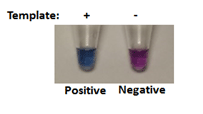
Fig1. Typical color change of Visual-PCR Mycoplasma Detection Kit. PCR reactions with or without template show different colors. Positive is blue, and negative is purple.
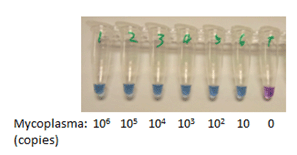
Fig2. Visual-PCR Mycoplasma Detection kit is sensitive. Different copies of synthesized 16s RNA genes of mycoplasma Orale were spiked into PCR cocktail, and then PCR was performed.
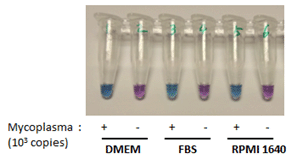
Fig3. Crude samples are directly used as PCR template. Culture reagents (DMEM, FBS, RPMI-1640) were spiked with mycoplasma (1000 copies/ul), and then were directly used as PCR template.
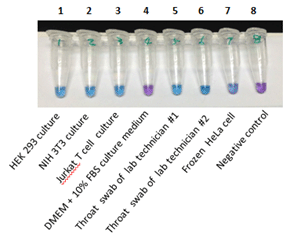
Fig4. Mycoplasma testing of a variety of crude samples from a suspicious lab. Crude samples were directly used as PCR templates without DNA extraction or sample pretreatment.
Additional Information
Kit Contents
- Component A, B and C: to prepare complete-PCR-cocktail
- Component D: positive control DNA template (synthesized 16s RNA gene of Mycoplasma orale)
Storage
- Product shipped on ice, store at -20°C upon arrival.
- Complete-PCR-cocktail once prepared should be stored at 4°C. It is stable for 1 month.
When To Test Mycoplasma
- Fail to reproduce published data
- Inconsistent, biased and skewed data
- Someone coughs or sneezes in the lab
- Culture a new cell line
- Obtain new cell lines from outside source
- Have not tested mycoplasma for 3 months
- Shared hood or CO2 incubator with others
- Cell culture manufacturing
- Production of cell related materials/products
Example Applications
- Research cell cultures, frozen cell lines
- Cell culture media and supplements
- Serum
- High titer CHO & NS0 cultures from bioreactors
- Cell culture vaccine & antibody manufacturing harvest
- Bioassay cell lines
- Stem cell & Lymphocyte proliferation cultures
- Cell and tissue therapy cultures
- Throat swab & Surface wipes
Mycoplasma Facts & More
15%-80% of cell cultures are contaminated. Please click here for more details on facts, how to minimize contamination, and challenges of detection.